
Artificial intelligence has passed the tipping point of usefulness. Today’s AI tools can generate marketing copy, summarize legal documents, write code, schedule meetings, and even diagnose illnesses. What once felt like science fiction now fits neatly into daily workflows. The question is no longer “What can AI do?” It’s “Can I trust what AI is doing?”
That’s a fundamentally different challenge.
For decades, the race in tech was to make things faster, easier, and more convenient. AI has delivered on that promise and then some. But with that convenience comes a new layer of complexity. When machines start making decisions or delivering recommendations on our behalf, we don’t just want them to be efficient, we want them to be right. And fair. And safe. And explainable.
In this new era, trust is the real currency. As AI becomes embedded in the fabric of business, government, and everyday life, organizations will need to stretch beyond functionality. They’ll have to earn confidence.
That’s especially true across generational lines, where trust in AI diverges sharply. And it’s why the next frontier in AI adoption isn’t building new tools. It’s building systems people are willing to rely on.
From Novelty to Normalcy: Convenience Isn’t Enough Any Longer
Not long ago, AI-generated content felt like magic. Early adopters marveled at ChatGPT writing decent emails or Midjourney producing surreal images from a few words. The “wow factor” fueled headlines and experimentation. But novelty has a short shelf life. Today, generative AI is embedded into tools we use without a second thought, like Microsoft 365, Google Docs, Salesforce, Canva, Notion, and more.
While the technology has moved fast, human psychology hasn’t kept pace.
A 2025 global study by the University of Melbourne found that while 66% of people now use AI regularly, only 43% strongly trust its outputs. The utility is there, but confidence is fragile. The more AI shows up in routine tasks, the more visible its mistakes become.
It’s not enough for AI to be smart; it has to be credible. People have seen what AI can do; now they’re asking harder questions: Is this output biased? Why did it recommend that? What happens if it’s wrong? Convenience has become table stakes. The real differentiator now is trust.
Generational Fault Lines in Trust
Trust in AI isn’t just a technological issue; it’s a generational one. In a recent Mindbreeze analysis, younger generations, especially Gen Z and younger Millennials, express greater trust in AI across a wide range of tasks, from research and creative work to even career guidance. In contrast, Gen X and Boomers are more cautious, voicing deeper concerns about AI’s objectivity, transparency, and implications for privacy and control.
Yet age isn’t destiny. A study published by Utrecht University in 2024 showed no statistically significant difference between younger and older participants in trusting AI-generated vs. real human faces—suggesting that experience and familiarity with AI tools may be more predictive of trust than birth year alone.
Even so, the broader pattern holds: Younger users often see AI as an augmentation tool while older users view it more as a threat or an unknown. This has real implications for business adoption. A company rolling out AI tools to its workforce or its customers can’t assume uniform trust levels. Strategies that work for digital-native employees may backfire with legacy teams who value control and explainability over speed and automation.
In short, generational trust in AI is not evenly distributed. And ignoring those differences is a fast track to friction, disengagement, and misuse.
Algorithm Aversion: When Better Isn’t Trusted
Even when AI performs better than humans, people often don’t trust it. This counterintuitive response, known as algorithm aversion, has been well-documented across fields like health care, finance, and education. The issue isn’t accuracy; it’s perception.
In a 2025 study published in AI & Society, radiologists who were given access to a high-performing AI diagnostic tool performed worse when they didn’t trust its output. Those who did trust it improved. The takeaway? Distrust doesn’t just neutralize AI’s value—it can actively degrade outcomes.
Algorithm aversion kicks in when users feel the system is opaque, when they can’t challenge the output, or when a single mistake shakes confidence, no matter how accurate the model is overall. One error by an algorithm is often judged more harshly than a human mistake.
This psychological barrier looms large in business settings. Leaders may deploy high-performing AI tools but still see lukewarm results, not because the models are bad, but because people don’t trust black boxes, especially when decisions have consequences.
Solving this isn’t just a technical problem; it’s a design and communication issue. And it requires companies to build not only better models but more trustworthy ones.
Business Consequences: Trust as the New Currency
For organizations, the consequences of this trust gap are increasingly tangible. AI’s potential to drive efficiency, automate tasks, and uncover insights is well understood. What’s less appreciated is this: AI will only scale to the extent that people believe in it.
Take Mastercard, for example. As it explores the future of autonomous agents, AI systems now negotiate, transact, and execute on our behalf. The company has focused not just on innovation, but also on building trust into the infrastructure. Its Agentic Token and Agent Pay initiatives are designed with governance, transparency, and control at the core, signaling to both businesses and consumers that this isn’t a black box and the customer is in charge.
But many companies aren’t so forward-thinking. Despite AI’s rapid adoption, fewer than 8% of firms have mature AI governance frameworks, an alarming gap that undermines internal confidence, increases regulatory risk, and slows customer adoption. Industries that lead with transparency, like health care and finance, see faster adoption curves. Those that treat AI like a plug-in tool without oversight often run into backlash or disengagement.
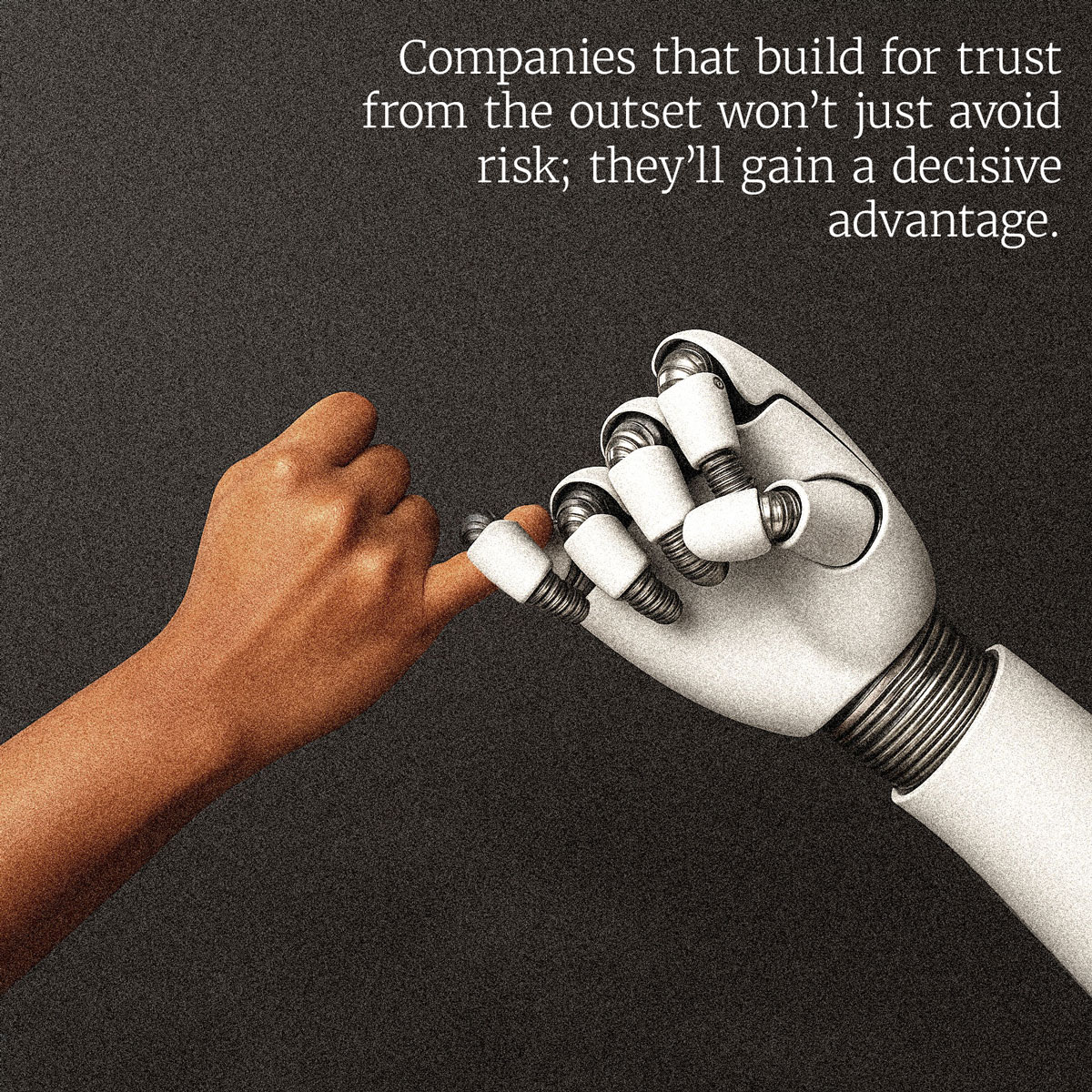
In this environment, trust becomes a strategic asset. It determines not only whether people will use AI, but whether they’ll rely on it. Companies that build for trust from the outset won’t just avoid risk; they’ll gain a decisive advantage.
Trust-First Design: Strategies for the Next Era
If trust is the new currency, then businesses need to design for it deliberately, not assume it will emerge organically. That means rethinking how AI is built, deployed, and communicated across the enterprise.
Here are five principles that define a trust-first AI strategy, along with practical ways to bring each to life.
1. Make it explainable, not magic.
People don’t trust what they don’t understand. One of the most effective ways to build confidence in AI systems is to provide clear, concise explanations for how outputs are generated. This doesn’t require opening the full technical black box, but it does mean offering logic, confidence scores, citations, or references where appropriate. For example, a recommendation engine that highlights “because you bought X and read Y” is far more trustworthy than one that delivers opaque results. Tools like LIME, SHAP, and model interpretability dashboards are becoming essential for customer-facing and internal AI tools alike.
2. Keep a human in the loop.
Fully autonomous decision-making may be the endgame, but in most organizations today, trust is built through collaboration. A human-in-the-loop (HITL) approach keeps users in control, turning AI from a threat into a co-pilot. Whether it’s content review, contract generation, or demand forecasting, users should have the final say. This not only reduces risk but also increases adoption. When people can challenge or modify outputs, they’re more willing to use AI in the first place. Over time, this “training wheels” model creates muscle memory for when (or if) automation ramps up.
3. Start where the cost of being wrong is low.
Trust builds from consistent, low-risk success. Instead of immediately applying AI to complex, high-stakes decisions like pricing, hiring, or compliance, start with use cases where errors are tolerable and benefits are clear. Summarizing documents, generating first drafts, or identifying patterns in large datasets are great starting points. These early wins create a track record that earns trust over time. They also help business leaders and teams develop realistic expectations. AI doesn’t need to be perfect; it just needs to be helpful and correctable.
4. Tailor the trust experience to the user.
What feels trustworthy to a Gen Z software engineer may feel risky to a Gen X finance lead. AI adoption strategies should be tailored by persona, team, and role. Transparency, oversight, and training levels should flex to match users’ comfort with automation. For example, seasoned operators may want detailed model inputs and audit trails, while younger teams may value speed and customization. The most effective AI rollouts come with segment-specific onboarding—explaining not just what the tool does, but why they should trust it. A one-size-fits-all approach guarantees adoption gaps and resistance.
5. Make governance part of your product narrative.
Most organizations treat governance as a backstage function. But in the age of AI, it should be part of the show. Communicating your oversight model, data handling policies, model testing protocols, and ethical review boards signals that your business takes responsibility seriously. This doesn’t mean publishing source code, but it does mean being transparent about how tools were built and evaluated. When customers and employees know a system has been vetted, they’re more likely to trust it and use it. Governance, when visible, becomes a competitive advantage.
Trust Is the True Differentiator
AI has delivered on the promise of convenience. It can do more, faster, with less effort than most imagined even a few years ago. But that’s no longer enough. The new frontier isn’t about proving what AI can do; it’s about earning the confidence that it should.
In that sense, trust is no longer just a compliance checkbox or UX detail; it’s a strategic imperative. It determines whether people will engage, adopt, rely, and advocate, or whether they’ll opt out, override, and resist. For business leaders, that makes trust not just a byproduct of good AI; it makes it the product.
As we move from experimentation to scale, from novelty to ubiquity, organizations that design for trust from the start will lead. They won’t just build better systems; they’ll build lasting relationships with the people who use them.
And in a world of accelerating automation, that may be the most human advantage of all.
