
Is your news feed full of artificial intelligence (AI) doomsday headlines? Too soon we forget that each generation reimagines the dangerous impact technology has on us. “Don’t sit too close to the TV.” “Don’t stand too close to the microwave; it will cause cancer.” When the radio was invented, headlines reported that children ignored reading and school.1 The internet ignited fears like “Is Google Making Us Stupid?” Yet, along with these technological advancements, we exist in a world today with the lowest crime rates, lowest poverty rates, fewest deaths from natural disasters, highest life expectancy, most educated population, fewest labor hours worked, and highest productivity rates in all of history (citation).
Imagine a world where technology fundamentally transforms every aspect of life. Picture stepping outside and effortlessly boarding an autonomous vehicle that knows your schedule and routes, eliminating traffic woes with precision. All deliveries arrive at your chosen time and day, making waiting obsolete. A personal assistant automatically tracks your nutrition, while wearable devices detect health issues early, improving treatments and outcomes. Real-time translators in your pocket dissolve language barriers, making verbal international communication a part of everyday life. These AI-driven innovations free up your time, allowing you to focus on what truly matters: personal growth, family, and the pursuits you love. Life becomes longer, healthier, and infinitely more enjoyable.
In this article, we will explore the exciting prospects ahead, knowing that fear will subside, and what companies can do now to prepare for an AI-driven future.
How We Got Here
AI’s journey began long before the groundbreaking release of ChatGPT on November 30, 2022, which amassed 1 million users in just five days and 100 million in two months. AI has transitioned from being a staple in futuristic narratives to reality, evolving from early computer science experiments to sophisticated algorithms like machine learning, deep learning, and natural language processing (NLP).
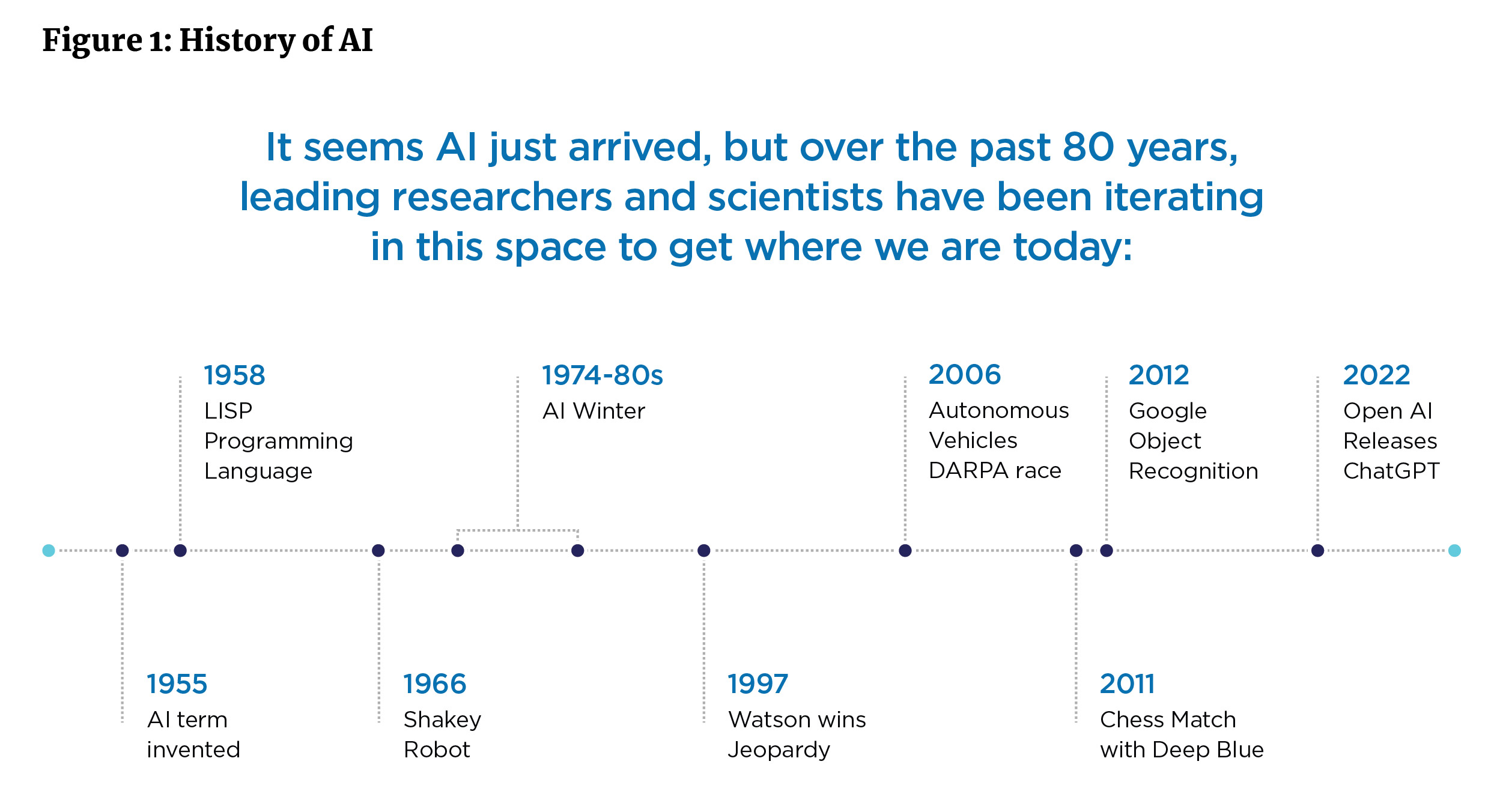
The origins of AI trace back to the 1950s, when pioneers like Alan Turing and John McCarthy laid the groundwork. Turing’s seminal question, “Can machines think?” and McCarthy’s coining of the term “artificial intelligence” in 1955 sparked a wave of innovation. Early AI focused on symbolic reasoning and rule-based systems, with limited success due to limited computing power.
The 1980s saw the rise of expert systems, which attempted to emulate human decision-making in specific areas. Despite initial success, these systems faced scalability issues and a lack of adaptability. The advent of machine learning in the 1990s marked a significant shift, as AI systems began learning from data rather than relying on explicit programming.
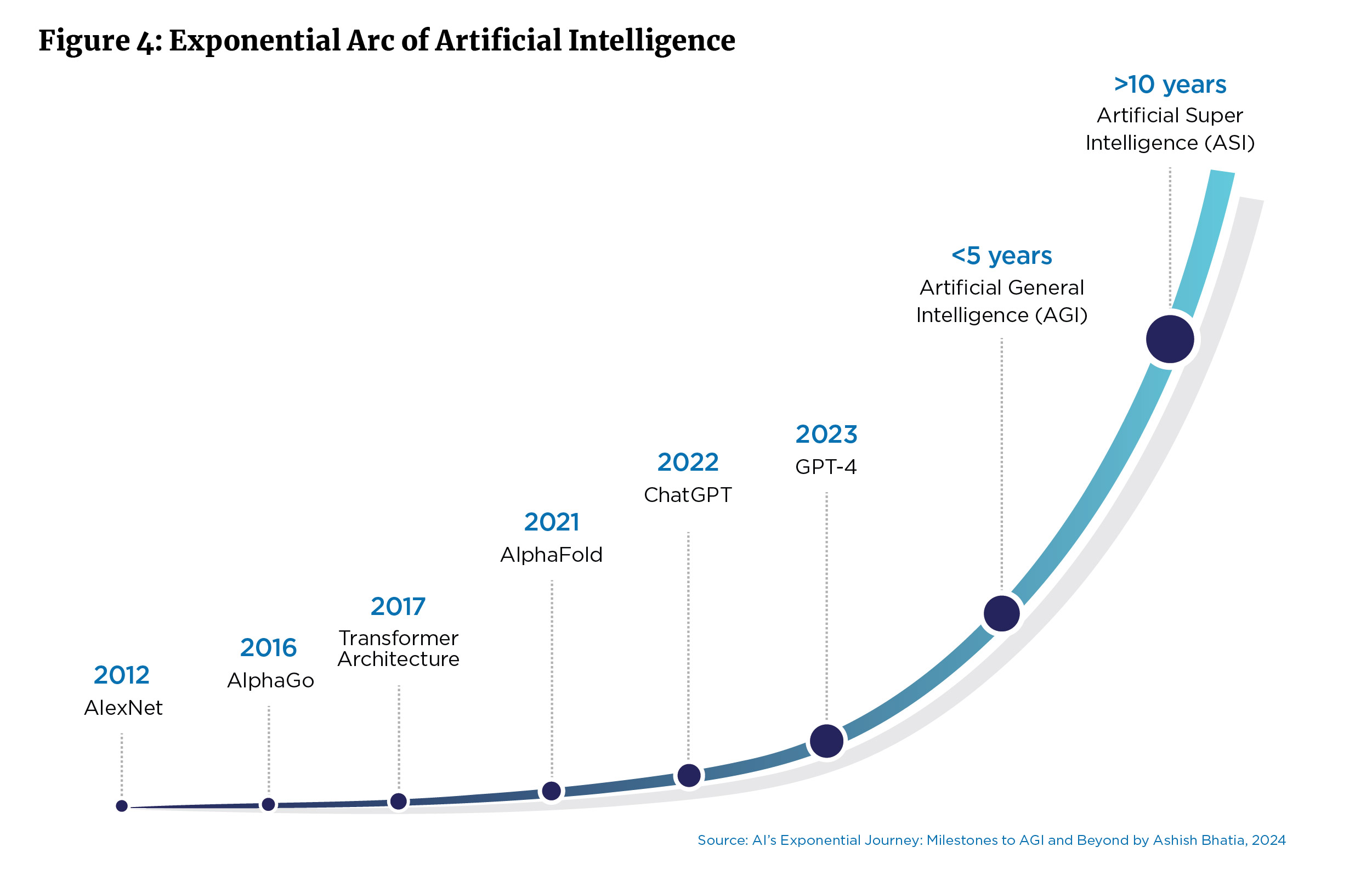
In 2016, AlphaGo’s triumph over a world champion in Go—a very complicated strategic board game— highlighted AI’s remarkable strategic prowess and adaptability. Unlike its predecessors, which relied on preprogrammed strategies, AlphaGo wasn’t programmed with strategies. It learned them.
In 2021, Google’s DeepMind’s AlphaFold algorithm solved one of biology’s greatest conundrums by predicting the shape of every protein in the human body, demonstrating the profound potential of AI to solve complex scientific problems. Now in 2024, AlphaFold 3 just released a revolutionary model that can predict the structure and interactions of all life’s molecules with unprecedented accuracy, unlocking an ability to develop life-changing drug treatments for patients.
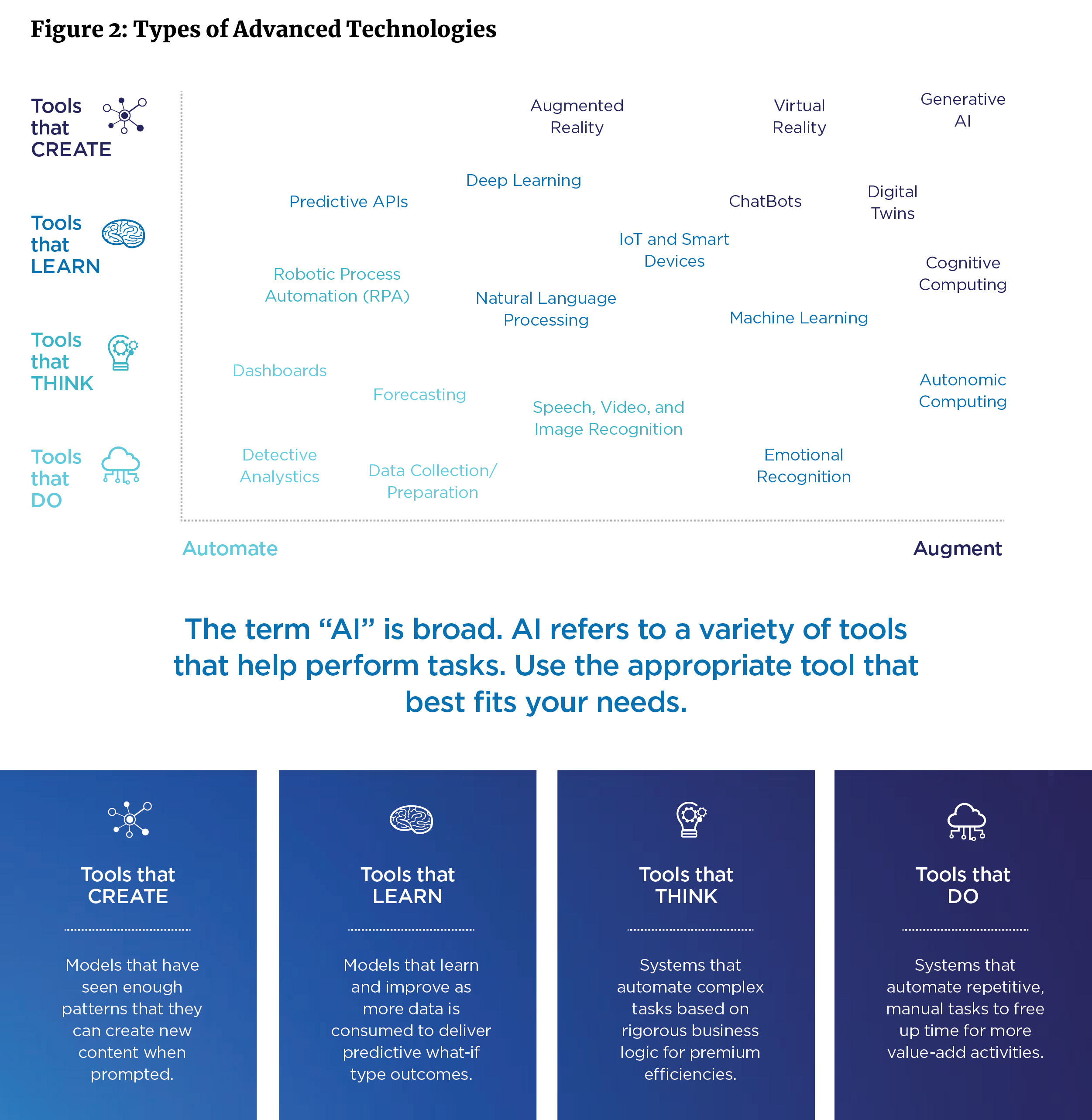
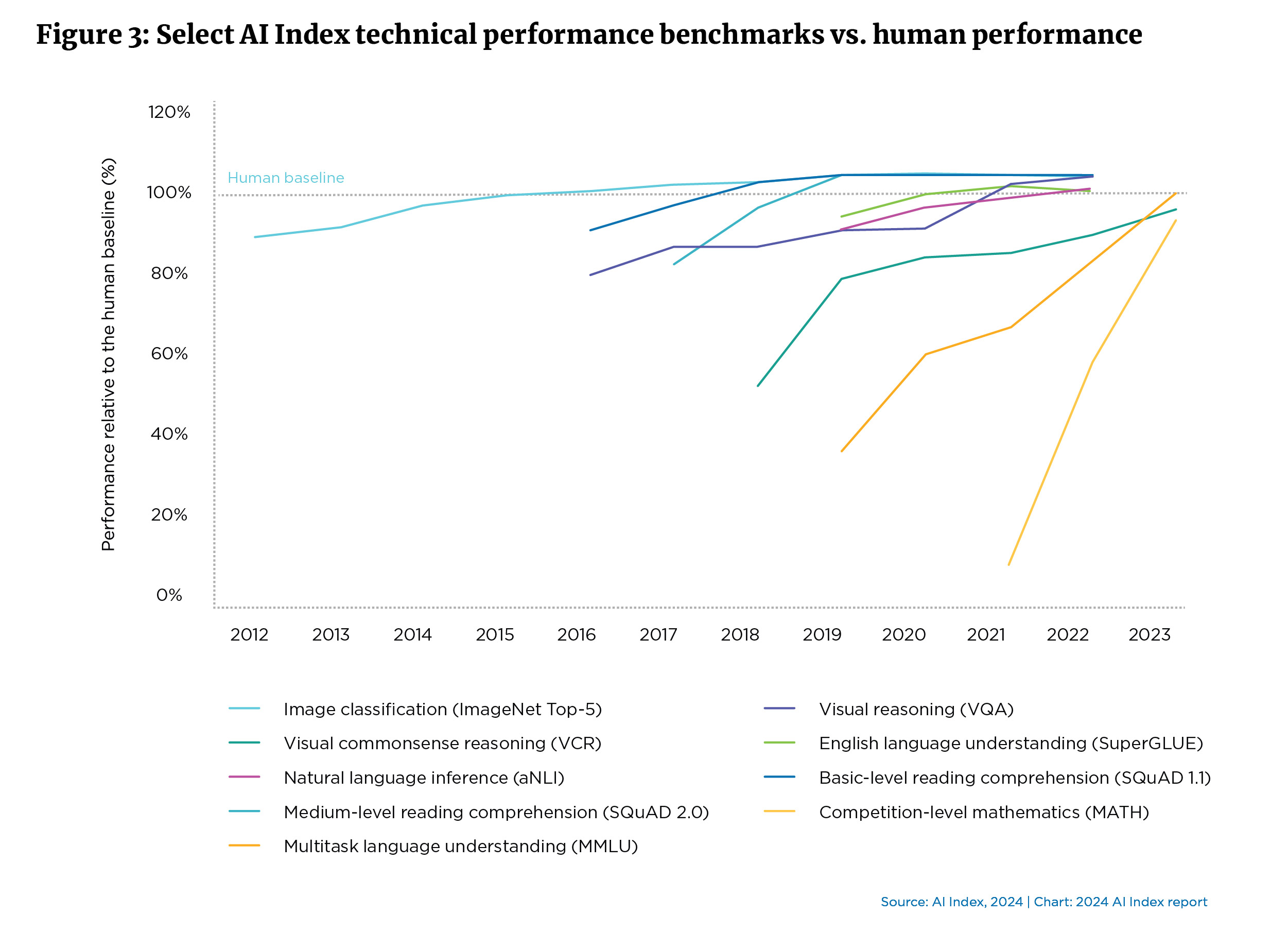
The term AI is used quite broadly in everyday conversations. All these milestones are variations of AI being benchmarked against human performance—the ability to do, think, learn, and create (Figure 2). Different types of advanced technologies can automate or augment human tasks. The concept of replacement is often a misnomer because humans will always need to create and, more importantly, maintain or monitor tasks performed by AI. Figure 3 illustrates how various types of AI technical skills are also quickly approaching or surpassing a human baseline of performance.
The 21st century has witnessed exponential growth in AI capabilities, driven by advances in computational power, data availability, and algorithmic innovation. The rise of deep learning, characterized by neural networks with multiple layers, has revolutionized fields like computer vision, natural language processing, and speech recognition. AI is now becoming part of our lives, from virtual assistants like Siri and Alexa to recommendation systems on Netflix and Amazon. AI will soon be omnipresent, seamlessly integrated into nearly every aspect of our daily lives, much as the internet has become indispensable today.

Where We’re Going and What Lies Ahead
In the next decade, AI will revolutionize various sectors. Emerging technologies such as quantum computing and advanced neural networks will drive unprecedented advancements. In healthcare, AI will enable personalized medicine and predictive diagnostics. Education will benefit from adaptive learning platforms and personalized tutors. Autonomous vehicles and smart traffic management will transform transportation. Daily life will be enhanced by AI in home automation, entertainment, and personal assistants.
AI’s potential to drive economic growth is immense. According to a study by PwC, AI could contribute up to $15.7 trillion to the global economy by 2030.2 This growth will be driven by increased productivity, new product and service offerings, and the automation of routine tasks. This growth will likely converge more conversations around a four-day work week, similar to how Henry Ford’s transition from a six- to a five-day work week in 1926 boosted productivity and loyalty, and allowed more leisure spending, ultimately benefiting the economy.3
Even on our current trajectory, ignoring potential disruptive innovations, we are still on a path of incredible growth. In the next decade, we may see the advent of Artificial General Intelligence (AGI) and Artificial Super Intelligence (ASI), which promise to propel us into an era of unprecedented technological and societal advancements, making the future an exciting frontier of possibilities (Figure 4). In this future, AI not only performs tasks but also innovates, creating solutions to problems we haven’t yet conceived, fundamentally transforming the way we live, work, and interact with the world around us.
Exciting Future Prospects of AI and Interesting Use Cases
Healthcare
AI-assisted surgeries, predictive diagnostics, and personalized treatments will revolutionize medical care. AI algorithms can analyze medical images with higher accuracy than human radiologists, detecting anomalies earlier and improving treatment outcomes. Personalized, predictive analytics with the help of wearable devices will enable healthcare providers to identify high-risk patients earlier and intervene proactively, reducing hospital readmissions and improving population health. “Your heart skipped a beat” takes on a new meaning.
Education
Adaptive learning platforms, AI tutors, and improved accessibility will transform education. Every person learns differently, whether auditory, visual, hands-on, interpersonal, intrapersonal, etc. Personalized AI tutors will cater to each student’s unique learning style, ensuring that they receive instruction in the way that suits them best. AI-driven content curation will provide students with personalized learning experiences, catering to their strengths and weaknesses. Virtual classrooms and AI-powered assessment tools will enable continuous evaluation and feedback, fostering a growth mindset. Enhanced accessibility features will ensure that students with disabilities receive the support they need to succeed.
Transportation
Autonomous vehicles, smart traffic systems, and optimized logistics will redefine transportation. Self-driving cars will reduce accidents, while AI-driven traffic management systems will optimize traffic flow, reducing congestion, travel times, and emissions. Logistics companies will leverage AI for demand forecasting and route optimization, ensuring timely deliveries and reducing operational costs. Get where you need to go and what you need quickly and on time.
Daily Life
AI-enhanced home automation, entertainment, and personal assistants will elevate daily experiences. Smart home devices will learn our routines and preferences, creating comfortable and energy-efficient living environments. AI-powered entertainment platforms will curate personalized content, providing immersive experiences tailored to individual tastes. Virtual assistants will manage our schedules, answer queries, and handle routine tasks, freeing up time for leisure and creativity.
Robotics
Robotics will be at the forefront of transforming industries and daily life. Advanced robots equipped with AI will handle complex tasks in manufacturing, healthcare, and services with precision and efficiency. In manufacturing, robots will collaborate with humans on the factory floor, enhancing productivity and ensuring quality. Healthcare robots will assist in surgeries, patient care, and rehabilitation, improving outcomes and reducing workloads for medical staff. Service robots in homes and public spaces will provide assistance, enhance safety, and improve the quality of life. Imagine a future where robots can autonomously perform household chores, provide companionship to the elderly, and assist in disaster relief operations, showcasing the transformative potential of AI-driven robotics.
Real-world Examples
AI in disaster response, scientific research breakthroughs, and enhancing creativity in the arts will showcase AI’s positive impact. AI algorithms can analyze satellite imagery and social media data to provide real-time insights during natural disasters, aiding emergency response efforts. In scientific research, AI-driven simulations and data analysis will accelerate discoveries in fields such as genomics and climate science. AI tools will enhance artistic expression, enabling musicians, writers, and visual artists to explore new creative frontiers.

How Companies Can Prepare for the AI-driven Future
To thrive in an AI-driven future, companies must:
Ensure Accurate and Comprehensive Data
Data is the lifeblood of AI. Companies must invest in robust data infrastructure and governance to ensure data quality, accessibility, and security for both structured and unstructured data. Building a comprehensive data strategy involves identifying key data sources, implementing data integration and management tools, and establishing data governance frameworks.
Integrate AI Responsibly With Governance and an Operating Model
Responsible AI deployment requires adhering to ethical principles above and beyond data governance, such as fairness, transparency, and accountability. Companies should develop ethical guidelines and frameworks to ensure that AI systems are designed and used in ways that respect human rights and societal values. This includes conducting regular audits of AI systems to identify and mitigate biases, ensuring transparency in AI decision-making processes, and implementing mechanisms for accountability and redress.
Invest in AI Research and Development
Staying at the forefront of AI innovation requires continuous investment in research and development. Companies should collaborate with academic institutions, research organizations, and technology partners to advance AI capabilities and explore new applications. This includes participating in industry consortia, attending conferences and workshops, and staying informed about the latest developments in AI research. Some chief AI and innovation roles are considered “forever shoppers” who have a permanent place at the decision-making table, continually seeking new tools and technologies that can enhance business decisions.
Build AI Literacy and Skills Within the Workforce
Preparing the workforce for an AI-driven future involves upskilling employees and fostering a culture of continuous learning. Companies should provide training programs and resources to help employees develop AI literacy and technical skills. This includes offering courses on AI fundamentals, programming languages, data analysis, and machine learning techniques. Encouraging cross-functional collaboration and knowledge sharing can also help employees understand how AI can be applied to different aspects of the business.
Foster Collaboration Between Industries, Academia, and Governments for Equitable Innovation
AI development and deployment require collaboration among various stakeholders to ensure that benefits are shared equitably. Companies should engage with industry associations, academic institutions, and government agencies to promote responsible AI innovation and address societal challenges. This includes participating in policy discussions, contributing to public-private partnerships, and supporting initiatives that promote digital inclusion and access to AI technologies.
Learn From Successful AI Adoption Case Studies
Companies can gain valuable insights from studying successful AI adoption examples in various industries. Analyzing case studies of organizations that have effectively integrated AI can provide practical guidance on best practices, challenges, and lessons learned. This includes understanding how AI can be used to enhance customer experiences, streamline operations, and drive innovation.
AI has immense potential to transform our future positively. By viewing AI as a tool for progress rather than a threat, individuals and organizations can embrace its advancements and contribute to its responsible development. The frontier of AI is filled with exciting opportunities that promise to enhance our lives in unprecedented ways. From personalized healthcare and adaptive education to autonomous transportation and intelligent home automation, AI is poised to revolutionize every aspect of our daily lives. As we navigate this exciting frontier, it is essential to prioritize ethical considerations, invest in continuous learning, and foster collaboration across sectors to ensure that AI benefits all of humanity.
References:
• Artificial Intelligence Applications, Simplilearn, accessed July 1, 2024
