
If you were to believe the articles you read in many or most business publications, you might feel behind in your implementation of AI solutions and the modernization of your data platform. And yet, when you look “behind the curtain,” most businesses are focusing their innovation on quick hits and obvious, short-term productivity solutions rather than stepping back and really looking at how modern technologies will impact their core business models. Many businesses are overindexing on technology solutions and underindexing on what will ensure that they drive business value. So while they seem to be moving quickly, you are not really behind because they are going in the wrong direction. To avoid the common pitfall of overindexing on technology solutions and underindexing on driving business value, you need to accept that in the future there will be no separation between your core business and technology. The sooner you break down the barriers between technology leadership and business leadership, focus on the core, and go for speed, the sooner you will get ahead in the race to data modernization.
Eliminate Walls Between IT and Business
Many organizations view their data modernization, artificial intelligence, or digital transformation (DM-AI-DT) projects as belonging to their IT organizations. While it is true that these are all technology solutions, they are fundamentally different from the legacy platforms that IT traditionally owns. For legacy platforms, success was historically measured by technical factors such as data accuracy and system stability, or project constraints like budget or timelines. But in this new age of modern data, success is determined by business outcomes, adoption and utilization, and ROI, so it depends on the quality and speed of interactions between technologists and business leaders. Companies will need to have technology embedded within the core of their business and have technologists and business leaders be one and the same. It will no longer be sufficient to have “world-class IT” and “world-class leadership” if the two aren’t embedded within each other.
Expect More Than Delivery Excellence
In addition, staffing an “ePMO” and efficiently focusing on the implementation of multiple platforms simultaneously while minimizing business disruption—yesterday’s panacea—will no longer be sufficient.
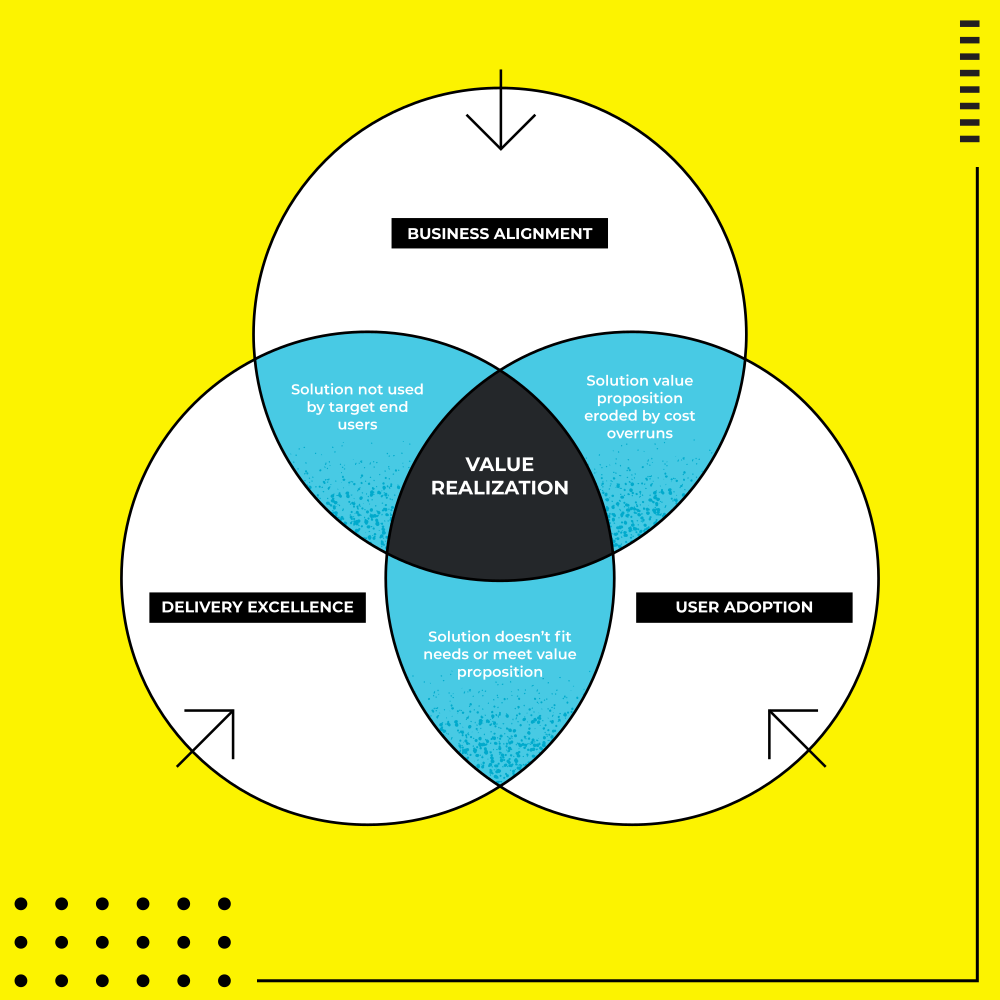
In fact, you are better off with poorer delivery excellence as long as you have a laser focus on Value and User Adoption. Typical PMO practices become less important while change management and value tracking, not dissimilar to how merger integrations are managed, rise in importance.
Avoid Shiny Object Syndrome
A large preponderance of DM-AI-DT initiatives suffer from “shiny object syndrome.” There is nothing wrong with new technology, but far too often it is implemented without an understanding of what business value can be driven without it, what alternatives may exist, and what the probability of success is post-implementation. Since large and complex technology initiatives can draw focus, time, and energy away from achieving business value, your DM-AI-DT leader should focus on using what you already have. You can make small changes like supplementing it with more robust processes or experimenting with historically underused features. A failed “shiny object” implementation does nothing for the company, but does shore up the resumes of everyone in IT who participated in the project.
We lean toward realizing value from companies’ current tech stack, supplementing only where it will improve business results through data accessibility and usability. One vendor solution that tends to yield a high ROI for businesses looking to modernize their data platform is moving from on-prem solutions to a cloud solution. While cloud computing has come a long way since its introduction in the 1950s, it has made its most notable evolution over the past two decades. Cloud vendors and their services are now seen as transformational drivers and the new operational standard instead of simply a platform to drive down costs. As business demands and adoption of cloud services rose, especially post-COVID-19, vendors matured in operational efficiency, security, and service variety. They can help companies make serious progress in data modernization.
Focus on the Core
As we mentioned in the introduction, many of the businesses that are taking steps to implement DM-AI-DT are doing it in obvious ways, in “safe spaces,” to achieve quick hits. Some examples of these “safe spaces” are call centers and back-office functions that enhance productivity. These projects typically appear to have a solid ROI that can be approved by traditional decision-making criteria deeply embedded in legacy organizations. The issue is that these projects take up a lot of time and mind-share of the organization while having little to no impact on the business’s core. Meanwhile, more digital-driven organizations, perhaps those that had a digital “backbone” from the beginning, are able to focus on the core—which, when complete, becomes an existential threat to not only your company but the entire industry.
Maintain Business Alignment
Every leader in your business should understand your DM-AI-DT strategy. Every leader should be not just encouraged, but expected, to be a challenger. There are no bad ideas. Quarterly business reviews should be 50% on today’s performance and 50% on DM-AI-DT. Bring them along. Train them. Have your leadership team see, touch, and feel the work. In a few short years, their jobs will depend on their ability to be part of what today may be a skunkworks but tomorrow will be your primary MO.
Ensure User Adoption
Involve users in whatever solutions you are piloting early. It doesn’t matter how elegant the solution is if customers, users, and expected adopters don’t adopt. Expect to spend about 33-66% of your resources on usability, customer experience, change management, process improvement, and other areas that are not directly tied to technology. The big “aha” moment comes when you have a cohesive solution to a DM-AI-DT approach for your industry that not only aligns as a technology, but comprehensively includes strategy, process, and people as well.
Manage to Value / Manage to Cash
This isn’t a project or program to be managed by IT. It should be managed by one of the “stars” of your leadership team. The technology piece of this work is far less important than the value portion. The leader should keep a close eye on value differentiation for your customers, your partners, your suppliers, and your employees, in addition to your business. And value isn’t fluffy. Value is cash.
Go for Speed
After “Focus on the Core,” going for speed is the second most important thing you need to do. The argument for speed is the same as the argument for the core. Companies that “figure out” the DM-AI-DT business model for their industry first and implement it will have scale and “first mover” advantages that will be difficult to impossible to supplant, leaving followers with lower returns and fewer opportunities for the future. So how do you accelerate what you are doing?
Use existing technologies where sufficient – use what you have, it is already there!
Experiment and pilot – don’t wait for the intellectually “right” answer.
Reward failures – learning and adapting are the rewards for trying something that didn’t work.
Break your ROI mentality – remember that the call center project will have a higher “ROI” but will do nothing to protect you from the DM-AI-DT future.
Make an acquisition – acquire a company that is ahead to jump-start your process.
Separate the DM-AI-DT team from day-to-day operations – this isn’t a part-time job.
Invest sufficient executive time – this has got to be one of the few “big rocks” your company has to get right.
Concurrent with an aggressive focus on applying DM-AI-DT to your core business model, we advocate for building the ancillary modern data platform over time, through the following methodology:
- Identify and value individual use cases.
- Group use cases based on the commonality of data required to implement the use case.
- Prioritize groupings of use cases based on their ROI and their relatedness to value creation for customers or quasi-customers.
- Implement data modernization of the first grouping, ensuring value creation.
- Have a final “modern data platform” in mind while refraining from letting an elegant, final platform take the place of value creation in the intermittent stages.
- Never let this “digital incrementalism” interfere with the primary DM-AI-DT work on your primary business model.
Start Now and Prepare to Win
A cursory look at the business press leaves many executives feeling behind in their use of data, analytics, and AI in driving business value. But some of those companies that are seemingly out in front are actually going in the wrong direction as they focus on quick hits and obvious answers. Companies that start soon but focus on their core, go for speed, and break down the barriers between technology leadership and business leadership can follow a path to digital excellence and compete and win for decades to come.
