
It is fairly obvious that artificial intelligence (AI) will reshape how we live, work, and play in short order. Over the past year, it seems that everyone is experimenting with generative AI to simplify everything from writing, research, and analysis in business to planning vacations, trying new recipes, and blog posting at home. It is clear that personal productivity will blossom, leading to either a large reallocation of the workforce, or massive dislocation and upheaval, raising new societal questions that will require creative solutions.
But beyond personal productivity, how will AI impact industries? Many companies and researchers already have some idea how AI will impact things. It is important for those not currently “ahead” in the AI race to get up to speed quickly and close the gap so that they don’t get left behind. In this article, we’ll outline some substantial industry changes that are currently taking place or will take place over the near term. By understanding different industries and thinking creatively about your business, you can begin to identify hypotheses that will change your company or industry’s business model.1
Before we get to talking about the impact on specific industries, let’s talk about a 2 x 2 framework that can be used to classify industries in order to identify the potential impact of AI. For this analysis, we choose tangible vs. intangible offers and regulated vs. unregulated industry as the two axes. For further analysis, you could replace one of the axes with “Capital Intensity” and leverage the discussion below on pharmaceuticals and metals as a starter. Try it out!
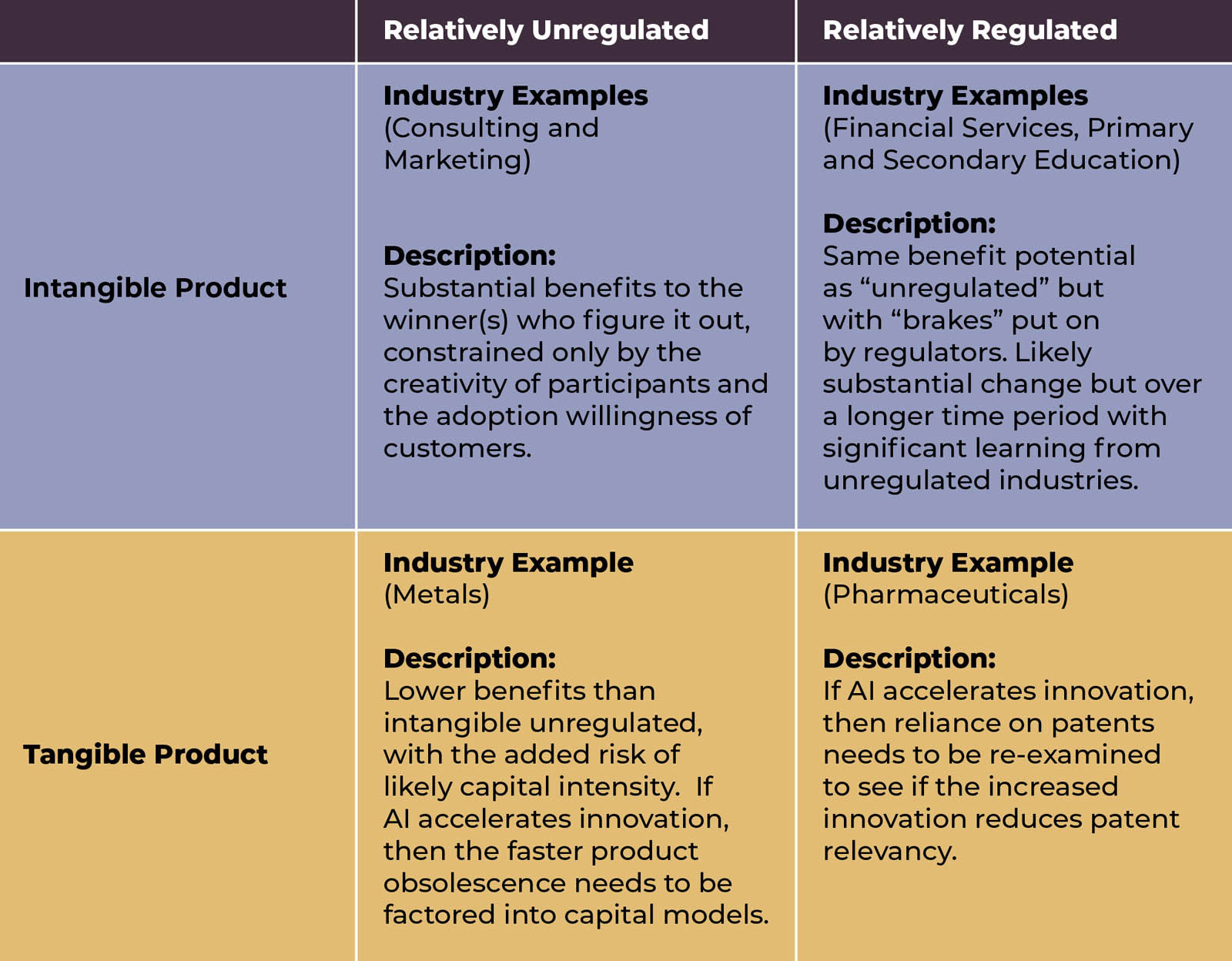
Intangible industries such as consulting and marketing can be highly disrupted by AI, and the resultant speed of change is controlled only by the creativity of the industry, the willingness of customers to adopt the change, and the degree to which the changes are regulated.
In the case of an industry like consulting in which there is little to no regulation, change can be swift and aggressive. Of course, within consulting there are many different types of firms. To the extent the firm relies on creativity and original thinking for its competitive advantage, a firewall against AI may exist for some time. If, on the other hand, a consulting firm’s advantage relies on its ability to collect and organize data from outside sources and clients, where the data is analyzed and findings are communicated clearly, then AI may be a significant disruptor. AI tools are already excellent at collecting, summarizing, and identifying patterns in data and are quickly improving in their ability to communicate the results.
Financial Services
Financial services have a diverse set of sub-industries, some of which are more lightly regulated than others. As analytics and AI have continued to improve, financial services firms are less reliant on credit agency ratings to determine the loan worthiness of consumers, and businesses instead are relying on their own data collection. Firms such as Capital One continue to evolve in their traditional and generative AI initiatives, place data at the core of their strategies, and seek to use AI as a competitive advantage in their offerings and even in their compliance.2 In the more regulated areas of finance, such as mortgages and automotive loans, firms need to understand “why” models make the recommendations that they do and ensure that these recommendations are in compliance. For this reason, many financial institutions are focusing on how to have their employees “in the loop” of decision-making to reduce risk and increase compliance. They gain the benefits of AI doing routine tasks while maintaining human oversight for decision-making.
Primary and Secondary Education
The business of educating children from ages 0 to 18 is highly regulated at the federal and state levels. There is a lot of resistance to change and technology replacing teachers, many of whom are unionized. At the same time, the benefits of AI-involved education are indisputable. In July 2024, Bill Gates visited First Avenue Elementary School in Newark, NJ, to see how it was using Khanmigo, an AI-powered tutor and teacher support tool developed by Khan Academy. Here is what he had to say:
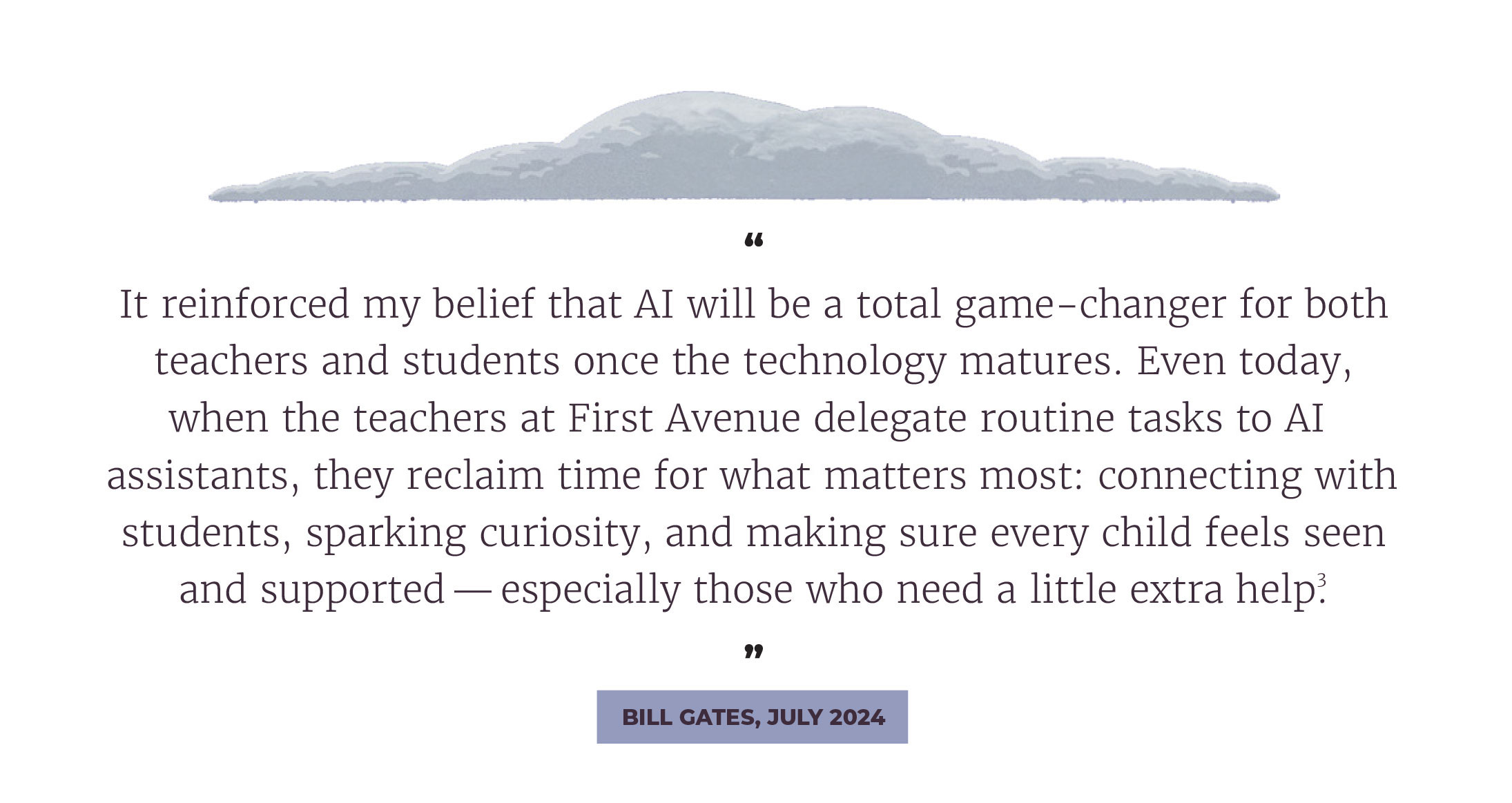
Khanmigo is free for teachers to use, and users espouse benefits including simplifying day-to-day prep, customizing education for students, and eliminating writer’s block.4
But this is just the beginning of how AI can truly transform education. Let’s take math education, for example. In a typical school in the US today, a teacher may have 20 to 40 students in their classroom at any given time. Even with decades of experience behind her, today’s teacher would not be able to customize each math lesson for each of those students in each class. Students would receive a math lesson that was tailored for most of them, and then while they practiced math problems the teacher would roam the room helping students individually. Students would also be able to stay after school or perhaps go in to school early for additional one-on-one math instruction. How could AI change this dynamic? Imagine if all the students in the classroom received the same math lesson from their computer. As they listen to the lesson, they could speed up the lesson if they felt they knew it already, pause the lesson, ask a question in the middle, or replay part of the lesson, all without impacting the learning style or speed of the students around them. Then, when students started applying the lesson to math problems, AI would really begin to show its advantages by:
1. Customizing the problem set to the individual student – As the student progresses through the problem set, AI can customize problems to make them harder or easier based upon the performance of the student.
2. Watching how the student answered the problem – AI can watch the method the student takes to solve the problem and recommend corrections and re-education where the student gets off track.
3. Listening and watching for frustration from the student and assisting in problem-solving – Computer vision and audio listening tools can already watch facial expressions, listen to voices, pick up on frustrations and struggles, and further customize problems and training to help students overcome challenges.
4. Re-teaching lesson parts based upon what the student did well, as well as where they struggled – As students progress, AI can customize training based on where each individual student is, not based upon the class average.
By working with millions of students over years of instruction, AI can continually improve its instruction while also improving its teaching mastery. This use of AI in math instruction would free up teacher time to focus on areas where student achievement is critical for success in the future, such as creativity and the ability to work in groups to solve more complex problems.
Healthcare
Healthcare is an area where there perhaps is even more potential for impact than primary and secondary education. AI is at its best when it has a lot of data to analyze and a large opportunity to make an impact. This fits healthcare perfectly! Imagine a world where hundreds of millions of people’s data is collected in a national database. Everyone’s test results and diagnoses would be recorded and this sanitized data made available to healthcare AI models focused on problems such as the early identification of cancer, prevention of Alzheimer’s disease, or prevention of heart attacks. These models would be able to understand the health patterns of people in their 50s, 60s, and 70s and the resultant conditions that are present, and to apply those patterns to participants in their teens, 20s, and 30s and identify health changes to prevent or delay diseases. Untold billions or trillions of dollars of savings to the healthcare system could result from these models.
AI is already reading X-rays, MRIs, and CT scans and is expected to save thousands of lives as it enhances or replaces radiologists. The exciting thing for patients is the more readings AI does, the better it gets, and it never retires and it never tires, meaning that the collective wisdom of AI only improves, leading to improved healthcare outcomes for generations to come.
Travel
Try using generative AI like ChatGPT to plan your next vacation. The tool will recommend restaurants, hotels, and other activities based on your inputs and requests. Hotel companies and other travel providers need to understand why generative AI recommends some hotels and not others, and how to increase their hotels’ standing within the tools to increase recommendations. Tool providers will have to decide how much to allow companies to skew results, if at all. Today it is unclear why some hotels keep showing up and others do not and how organizations may be able to influence this change. For almost 30 years, some within the industry have predicted that the internet, interactive mapping technology, and other tools would disintermediate brands by making location, quality score, and amenities the critical factors in hotel selection, for example. However, by using branding and loyalty programs, companies such as Marriott and IHG have maintained their intermediary status, with their brands being an indicator of quality, price, value, and loyalty. Will this finally change as AI continues to impact the industry?
Pharmaceuticals
AI is expected to shorten the drug development life cycle significantly for both new pharmaceuticals and improvements, such as reducing the impact of side effects, for example, of existing ones. How this impacts a company’s release plan, patent protection, scientist hiring, etc., is still anyone’s guess, but the impacts are expected to be profound. Google’s DeepMind was one of the early companies to show some success in this area, having focused on it since 2016 after its AlphaGo AI system beat the highest-rated human Go players. Google DeepMind’s AlphaFold program focused on sequencing amino acids and protein shape definition.5 This is useful because a protein’s shape determines what the protein does and what other molecules can do to it. Defining this is the goal of most of the world’s drug development.
Metals
Like pharmaceuticals, metals innovation can be impacted by leveraging generative (and other) AI to shorten the development of alloys. These alloys can improve things such as artificial limbs, automobiles, planes, spacecraft, buildings, and military gear. Amassing a wealth of data on metal alloys and then constantly learning and evolving through AI model deployment will be key to the industry finding success in this area.
Closing
AI will have a dramatic impact on this and all future generations of humankind and businesses alike. By being out in the forefront of creativity in thinking about how it will impact our lives, in both work and play, we have an opportunity to benefit from the technology rather than being on the short end. AI will certainly have an opportunity to widen the wealth gap and severely impact whole categories of jobs and employment. Only by understanding these changes as quickly as possible will we have the opportunity to minimize some of the burden and ensure that the coming productivity boom lifts all boats.
(NOTE: This article specifically leaves out three important topics: AI Governance, AI and Data Security, and Back Office Function Improvements:
AI Governance – AI Governance, such as approval processes for the use of AI, tool acquisition, funding, project management, and portfolio management, is very important. These topics are addressed elsewhere within the Jabian Journal and other Jabian publications and research.
AI and Data Security – Current generative AI models (for example) rely on a lot of public data. But they are also scraping data that they may or may not have approval to use. Ensuring that your proprietary customer and company data do not become part of the public domain and accessible to your competitors is incredibly important. Work with your team and your vendors to understand how to build a wall to protect your corporate assets while benefiting from advances in technology.
Back Office Function Improvements – Expect your current technology vendors in areas such as finance (ERP), supply chain, customer management (CRM), and call centers (among others) to build AI into their applications to help you quickly advance your productivity. If you aren’t happy with the speed at which your vendor is incorporating change and boosting your productivity, switch vendors. But please think long and hard before building proprietary AI on top of commercial applications for a whole host of reasons beyond the scope of this article. Focus your AI building on your unique value proposition to your customer and outsource your back office AI to vendors who make that their unique value proposition to you.
- https://journal.jabian.com/its-officially-time-to-self-disrupt
- https://venturebeat.com/ai/five-insights-into-how-capital-one-is-gaining-momentum-with-enterprise-ai/
- https://www.gatesnotes.com/My-trip-to-the-frontier-of-AI-education<
- https://www.khanmigo.ai/teachers
- https://www.economist.com/technology-quarterly/2024/03/27/artificial-intelligence-is-taking-over-drug-development?
